Australian Road Signs Explained
The signs the Australian knowledge test asks about, explained plainly: meaning, the rule, and where you meet each one.
Test yourself
Browse every road sign
Every road sign you will meet on the Australian knowledge test, grouped by type. Tap any sign for what it means, the rule behind it, and where you will see it on the road.
Showing 18
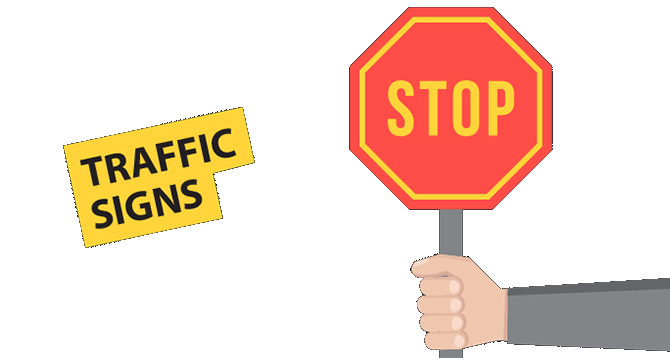
The Stop Sign
Come to a complete stop, then give way.
RegulatoryThe Give Way Sign
Slow down and let other traffic go first.
RegulatoryAustralian Speed Limit Signs
The maximum legal speed for that road.
RegulatoryThe School Zone Sign
Reduced speed limit at posted school times.
RegulatoryNo Entry Sign
You must not drive past this point.
RegulatoryOne Way Sign
Traffic travels in one direction only.
RegulatoryKeep Left Sign
Pass to the left of the island it marks.
RegulatoryNo Parking Sign
Brief drop-offs only — you cannot park.
RegulatoryThe "No Overtaking or Passing" Sign
You must not overtake while it applies.
WarningTraffic signals ahead sign
Warns that traffic lights are ahead.
WarningThe Roundabout Sign
Roundabout ahead — give way to traffic in it.
WarningPedestrian Crossing Sign
A marked pedestrian crossing is ahead.
WarningRailway Level Crossing Sign
Rail crossing — trains have right of way.
WarningMerge Sign (Australia)
Two lanes are about to become one.
WarningThe Slippery Road Sign
Road may be slippery — slow down.
WarningBicycle and Shared Path Signs
Cyclists share the road ahead.
Free Road Signs Practice Test (Australia)
Take a free Australian road signs practice test online. Learn how signs are examined in the learners…
Road Sign Shapes and Colours in Australia, Explained
Learn the visual grammar of Australian road signs — octagon means stop, red means prohibition,…
Nothing matches your search.
Check the official source before you rely on this
Rules and pass requirements are set by each state and territory road authority and can change. Always confirm the current details with the official source for your state — Transport for NSW, VicRoads (Victoria), Queensland Transport, or the equivalent authority where you live. This page is a free study guide, not a substitute for the official handbook.
Last verified 4 September 2026 against the Australian Road Rules and your state road authority. Rules, fees and figures change. Always confirm current details with your state road authority before you rely on them.
Frequently Asked Questions
- What’s the difference between a regulatory sign and a warning sign?
- Regulatory signs, such as Stop, Give Way, speed limit, No Entry and No Parking, set legal requirements you must obey. Warning signs, which are usually yellow diamonds like the roundabout, traffic-signals-ahead and slippery-road signs, alert you to a hazard or change in the road ahead so you have time to react. This guide explains both, sign by sign.
- What does a yellow diamond road sign mean?
- A yellow diamond sign is a warning sign: it tells you something is coming up on the road ahead, usually before you can see it yourself, so you can slow down and get ready. Examples on this page include the traffic-signals-ahead sign, the roundabout sign and the slippery-road sign. Unlike a regulatory sign, a warning sign does not by itself set a legal speed or command.
- Do road signs mean the same thing in every Australian state?
- The common regulatory and warning signs work the same way across the country, which is why this guide explains them for Australia as a whole. Even so, the underlying rules and pass requirements are set by each state and territory road authority and can change, so confirm the current details with the official source for your state, such as Transport for NSW, VicRoads or Queensland Transport.