Test yourself
What a Stop sign actually demands
The sign at a glance
| Category | Regulatory |
| Shape | Octagon (eight-sided) |
| Colours | Red with a white border and letters |
| Standard | AS 1742 (Australian Standard for traffic signs) |
| Appears in | All states and territories |
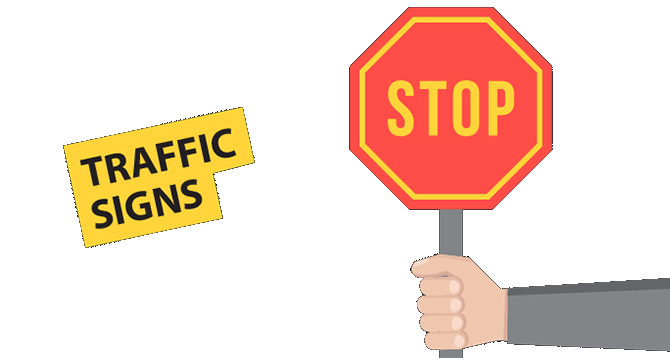
The Stop sign carries the single strictest instruction on any Australian road: you must bring the vehicle to a complete standstill. That means the wheels stop turning — not slow, not creep, but stop. It applies unconditionally. There is no version of the rule that lets you glide through because the cross street is empty at 6am, or because you can already see clearly in both directions. Under the Australian Road Rules you stop first, then look, then give way — in that order. Many learners assume the sign is advisory when traffic is light. It is not. A camera, an examiner, or a police officer only needs to see the wheels still moving to record it as a failure to stop. The complete stop also protects you legally: if a crash happens and you did not stop, fault sits heavily with you. Treat every Stop sign as a hard, mechanical full-stop — a genuine moment where the car is completely motionless before anything else happens. If you build that habit early, it becomes automatic and one of the easiest marks to secure on your test.
Why the Stop sign exists — and why it’s the only eight-sided sign
Stop signs are not placed casually. A traffic engineer installs one, under the AS 1742 signage standard, only where a Give Way sign is not enough — usually because sight lines are so poor that a driver cannot safely judge a gap while still moving. Picture a side street meeting a fast road where a fence, hedge or bend hides oncoming cars until the last second. Forcing a full stop buys the driver the time to turn their head, check both directions properly, and commit only when they are certain. The octagonal shape is deliberate and clever: the Stop sign is the only eight-sided sign on the entire network. That means its outline is recognisable from behind, in fog, at night, or when the face is caked in dirt or partly hidden by a branch — you can identify it as a Stop from its silhouette alone. The bold red colour reinforces the same message the octagon carries: this is an absolute instruction, never a suggestion. Understanding the ’why’ helps you respect the sign even at the quietest intersection.
Where you’ll meet Stop signs
You’ll find Stop signs at intersections without traffic lights where visibility is restricted, at busy T-intersections where a minor road joins a major one, and at the exits of car parks, service stations and driveways onto a main road. They also appear where a road crosses a railway line without boom gates, and occasionally on narrow bridges or single-lane sections. The common thread is danger combined with poor sight distance — the two conditions that make simply slowing down unsafe. In the Australian Road Rules, Rule 67 covers Stop signs and stop lines at intersections without traffic lights, while Rule 68 covers them at other locations such as level crossings and bridges. Wherever you find one, the obligation is identical: a full stop, then give way. On your driving test, examiners deliberately route you past Stop signs precisely because they reveal whether you truly stop or merely slow. Expect at least one on the day, and treat it as a marked, deliberate moment rather than something to rush through.
Exactly what to do, step by step
First, spot the sign early and start easing off well before it — a smooth, controlled approach reads far better than a last-second brake. Second, stop as near as practicable to the stop line but before it; if there is a solid white stop line painted on the road, your front bumper must not cross it. Third, if there is no line, stop before the point where the roads actually meet, at the spot where you can see. Come to a genuine standstill — feel the car settle on its suspension. Fourth, now look: right, left, and right again, scanning for cars, bicycles, motorcycles and pedestrians. Fifth, give way to everyone — under Rule 69 you must give way to any vehicle or pedestrian in or approaching the intersection. Sixth, only when there is a safe gap, move off smoothly and confidently. If your view is still blocked after the line — by a parked car, fence or wall — you may edge forward slowly to a second point where you can see, and stop again before proceeding. Two careful stops beat one blind guess.
Stop sign versus Give Way — the difference that catches people out
This is the confusion that costs the most test marks. A Give Way sign lets you keep rolling if the way is clear — you only stop if something is coming. A Stop sign removes that choice entirely: you stop every time, no exceptions, whether the road is empty or packed. Learners who have practised with a parent sometimes pick up the habit of treating a Stop like a Give Way when nobody’s around — a rolling stop, or ’California stop’. It feels efficient and it is completely wrong under Australian law and on the test. The other half of the confusion runs the opposite way: some nervous learners stop correctly but then freeze, giving way when they actually have a clear, safe gap, and holding up traffic behind them. The real skill is doing both halves well — a genuine, full stop, followed by a confident, safe move-off. Say it to yourself at every Stop sign: stop completely, then go when it is genuinely clear. Master that rhythm and Stop signs stop being stressful.
Where you’ll see it
At intersections without traffic lights where visibility is poor, at T-intersections where a minor road meets a major one, at exits from car parks, service stations and driveways onto main roads, and at some railway level crossings and narrow bridges.
Common mistakes learners make
- Doing a "rolling stop" — slowing to walking pace but never actually bringing the wheels to a standstill. This is the single most common Stop-sign fail on the driving test.
- Stopping past the stop line, so the front of the car crosses into the intersection before it has fully stopped.
- Treating the Stop sign like a Give Way sign when the road looks empty — the law requires a full stop every time, traffic or no traffic.
- Stopping correctly but then failing to give way properly — pulling out in front of a vehicle or pedestrian that had the right of way.
- Freezing after the stop and refusing a clear, safe gap, which holds up traffic behind and can also draw a fault from the examiner.
- Not edging forward to a second safe stopping point when a parked car, wall or fence still blocks the view past the stop line.
Last verified 4 September 2026 against the Australian Road Rules and your state road authority.
Check the official source before you rely on this
Rules and pass requirements are set by each state and territory road authority and can change. Always confirm the current details with the official source for your state — Transport for NSW, VicRoads (Victoria), Queensland Transport, or the equivalent authority where you live. This page is a free study guide, not a substitute for the official handbook.
More road signs
Keep going — tap another sign to see what it means and where it appears.
Bicycle sign
Bicycle and shared path signs in Australia: what they mean, the bike-lane rule,…
Give way sign
A Give Way sign means slow down, be ready to stop, and let…
Keep left sign
The Keep Left sign means pass to the left of that island or…
Merge sign
A merge sign means two lanes become one. Learn the Australian give-way rule…
No entry sign
A No Entry sign means you must not drive past it. Learn what…
All road signs
Browse every sign on the knowledge test.
Frequently Asked Questions
- Do I have to fully stop at a Stop sign if the road is clearly empty?
- Yes, every single time. A Stop sign requires you to bring the vehicle to a complete standstill - the wheels stop turning - at the stop line, even when the cross street is empty and you can already see both ways. Slowing to walking pace without actually stopping is a ’rolling stop’, which breaks the law and is the single most common Stop-sign fail on the driving test.
- What’s the difference between a Stop sign and a Give Way sign?
- A Give Way sign lets you keep rolling if the way is clear - you only stop if something is coming - whereas a Stop sign removes that choice and requires you to stop completely every time, whether the road is empty or packed, and then give way. Treating a Stop sign like a Give Way when nobody is around is completely wrong under Australian law and on the test.
- Where exactly should I stop at a Stop sign?
- Stop as near as practicable to the stop line but before it - if there is a solid white stop line, your front bumper must not cross it - and if there is no line, stop before the point where the roads actually meet. If a parked car, fence or wall still blocks your view after the line, you may edge forward slowly to a second point where you can see and stop again before proceeding.